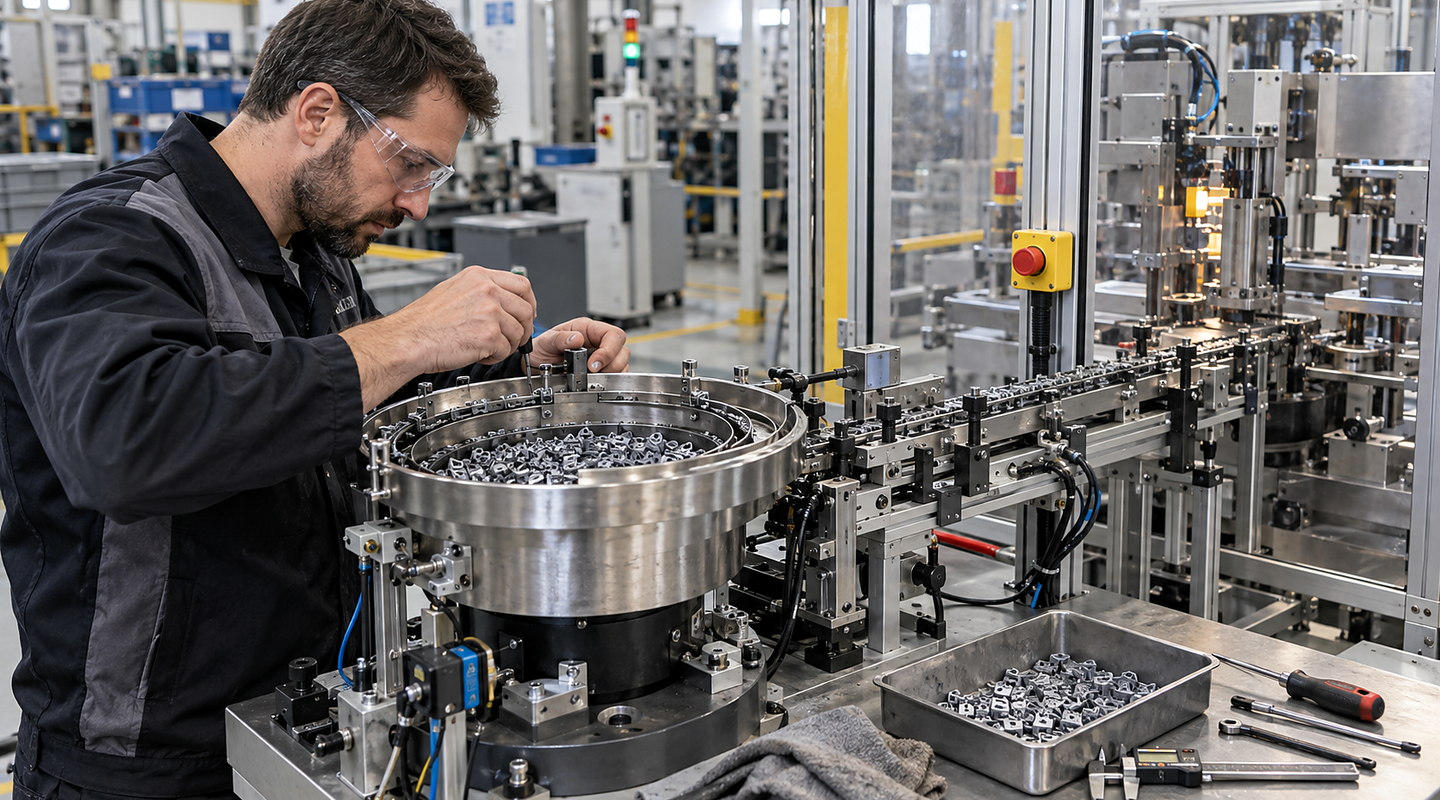
Feeder Hopper Loaders: How the Process Works
Follow the operating sequence for feeder hopper loaders, from preparing the input and controlling the main task to handling exceptions and checking results.
Feeder Hopper Loaders should be considered as part of a complete production sequence: inputs are prepared, the main task is controlled, exceptions are handled and results are checked.
For your application, the important details include component geometry and variation for bulk hopper loading for component feeders, surface, fragility and entanglement behaviour, bulk condition and replenishment method, and required orientation and delivery rate.
Understand the complete route from input to accepted output — Feeder Hopper Loaders
Plan feeder hopper loaders around real component variation, bulk condition, orientation, usable delivery rate and the downstream interface. Discuss representative part trials with Sorting Solutions. Follow the material or part through each operating step and include recovery, cleaning and change in the real cycle.
Discuss your application

Four clear stages for feeder hopper loaders
At each stage, you can review how component geometry and variation for bulk hopper loading for component feeders and jam, damage and recovery acceptance checks affect the next commitment.
- 01
Review Representative Production Components
Share representative production components and the downstream interface, including the normal range for component geometry and variation for bulk hopper loading for component feeders and the difficult surface, fragility and entanglement behaviour cases.
- 02
Trial Separation, Orientation and Presentation
Compare suitable methods and use focused trials to show how each option performs against bulk condition and replenishment method.
- 03
Develop Tooling, Controls and the Downstream Interface
Connect the equipment to your line, services and controls while resolving required orientation and delivery rate for day-to-day operation.
- 04
Challenge Delivery, Replenishment, Jams and Recovery
Confirm escapement and downstream pick interface, then complete and record jam, damage and recovery acceptance checks before your operating team takes over.
Decisions and results stay connected
| Stage | What happens | What you can review |
|---|---|---|
| Review Representative Production Components | Confirm the requirements for bulk hopper loading for component feeders, the operating range and the definition of a good result. | Your samples, current information and any points that still need confirming. |
| Trial Separation, Orientation and Presentation | Compare workable methods using component geometry and variation for bulk hopper loading for component feeders and surface, fragility and entanglement behaviour from your real production. | The trial method, observations and reason for the recommended route. |
| Develop Tooling, Controls and the Downstream Interface | Resolve bulk condition and replenishment method, required orientation and delivery rate and the physical, control, safety and data connections. | The agreed layout, line connections and any changes from the proposal. |
| Challenge Delivery, Replenishment, Jams and Recovery | Check normal, difficult and fault conditions before your team takes over the system. | Results for escapement and downstream pick interface and jam, damage and recovery acceptance checks, plus actions and operating information. |
Keep connected responsibilities clear
Your final feeder hopper loaders scope must also account for escapement and downstream pick interface, jam, damage and recovery acceptance checks, current regulations and the conditions at your site.
- Sample trials must include normal, marginal and supplier-variant components.
- Quoted feeder output is not the same as usable delivery at the downstream process.
- Fragile, flexible, magnetic or entangling parts may need a different presentation method.
Use hopper demand, delivery and arrival as separate events
A hopper controller needs to account for parts still travelling after a delivery command ends. Observe the physical route between the discharge and receiving feeder before changing timings or increasing capacity.
Define the working band in the receiving feeder
Agree what too few, useful working level and too many parts look like with the real component. Position and assess level sensing against that behaviour. A sensor looking at an unrepresentative corner can request a refill even while the main orientation area is crowded.
Measure the delayed arrival
During an agreed safe trial, record the time from starting delivery to the first parts arriving and the parts that continue to arrive after stopping. Include any elevator or chute between the two machines. This distinguishes a control delay from bridging or intermittent discharge without guessing a universal timer setting.
Test short and sustained downstream pauses
A short pause may only fill the usable buffer; a longer pause can change loading and recirculation upstream. Confirm how a full receiving feeder inhibits replenishment and how delivery resumes when demand returns. Keep low bulk supply, blocked discharge and a stopped receiving feeder as distinct operator messages.
Compare refill frequency with usable output
State hopper capacity in terms appropriate to the actual parts and bulk condition, then observe accepted output at the receiving machine. A larger bulk store changes refill frequency; it does not necessarily fix the cause of starvation. Keep replenishment behaviour in the trial record when comparing hopper concepts.